Best vinyl decal types for storefront window signage
Best overall for a low-gloss storefront finish: Matte Cal Vinyl. Best for a transparent film: Clear Cal Vinyl. Best for adhesive-free glass signage: White Static Cling. This guide compares the best vinyl decals for storefront windows by finish, adhesive, viewing direction, and the work required when a promotion changes.
TL;DR
The best vinyl decals for storefront windows match the removal plan: permanent adhesive and static cling serve different jobs.
Choose Matte Cal Vinyl for a low-gloss finish and Clear Cal Vinyl when transparent film matters.
Choose White Static Cling for adhesive-free glass signage, not as a substitute for permanent-adhesive vinyl.
Brooklyntransfers offers storefront decal materials; specify mounting side and viewing direction before ordering.
Why this matters
A window graphic has to do more than look right in an artwork preview. You need readable lettering, the correct mounting side, and a material that fits how you intend to remove or replace it.
Brooklyntransfers is best for print shops and brands ordering custom storefront decals alongside apparel transfers. For a 2026 storefront refresh, start with the material decision before building your production file. You can order custom stickers and decals through Brooklyntransfers; do not treat DTF apparel transfers and window signage as interchangeable products.
The practical split is permanent-adhesive vinyl versus adhesive-free static cling. Finish comes next. A glossy surface, a matte surface, and a transparent film solve different visual requirements, even when they carry the same artwork.
What makes the best vinyl decals for storefront windows?
Use these criteria before comparing materials. They keep the decision tied to the actual window rather than a product thumbnail.
Removal plan: Decide whether you want permanent adhesive or an adhesive-free application. Permanent adhesive is not a promise of easy removal.
Mounting side: Specify inside-glass or outside-glass installation and confirm that the chosen construction supports it.
Viewing direction: State whether customers read the graphic from the street or from inside. Mounting side and artwork orientation must agree.
Background and finish: Choose clear, white, glossy, or matte deliberately. Transparent film does not automatically make every printed element transparent.
Exposure: Describe direct sun, weather, cleaning, and any glass coating to the printer. Request confirmation for the actual application.
Production file: Supply final dimensions, readable artwork, and separate cutting instructions where needed. Do not leave placement decisions inside an ambiguous mockup.
Choose the removal method before choosing the surface finish. A promotion that changes regularly needs a different ordering conversation from permanent business hours.
Storefront decal types at a glance
These 2026 recommendations rank materials by distinct uses, not by an unsupported claim that one film lasts longest. Thickness identifies the listed construction; it is not a durability ranking.
7 mil white self-clinging film requiring no adhesive
White film does not provide a clear background
Glossy Cal Vinyl
A glossy storefront finish
3 mil glossy calendered vinyl with permanent adhesive
Gloss is the wrong choice when the brief requires matte
For each material, confirm the printed construction and application requirements before approving production. A material name does not establish inside-glass suitability, outdoor service life, or compatibility with every treated window.
3 mil glossy calendered vinyl with permanent adhesive.
$1.50
1. Matte Cal Vinyl: best storefront decal for a low-gloss finish
Matte Cal Vinyl is a 4 mil calendered vinyl with permanent adhesive. Choose it when the storefront brief calls for a matte surface rather than a glossy one.
This is the default recommendation for a low-gloss graphic, not a claim that matte eliminates reflections from the window itself. Inspect the proposed placement from the customer's viewing position before committing to the layout.
Matte Cal Vinyl pros:
Matte finish matches a low-gloss signage brief.
Permanent adhesive suits an adhesive-backed specification.
Defined 4 mil construction gives repeat orders a specific material reference.
Matte Cal Vinyl cons:
Permanent adhesive is not the same as removable adhesive.
A matte graphic cannot correct an unreadable layout or reflections elsewhere on the glass.
Best for: Business identification or promotional artwork where the specified finish is matte and permanent adhesive is acceptable.
Verdict: Buy Matte Cal Vinyl for a low-gloss, adhesive-backed window graphic after confirming the mounting application.
2. Clear Cal Vinyl: best storefront decal for transparent film
Clear Cal Vinyl is a 3 mil transparent calendered vinyl with permanent adhesive. Its defining advantage is the clear film, which makes it the relevant choice when a white film background conflicts with the design.
Check how the printed artwork should appear against the real storefront background. Clear material, white ink, and image opacity are separate production decisions; the material description alone does not settle them.
Clear Cal Vinyl pros:
Transparent film fits designs that do not call for a white film background.
Permanent adhesive provides an adhesive-backed option.
Specified 3 mil construction helps distinguish it from the other materials.
Clear Cal Vinyl cons:
Clear film does not guarantee opaque lettering or a white ink layer.
Transparent areas leave the changing storefront background visible.
Best for: Logos and lettering whose design specifically calls for transparent film around the printed image.
Verdict: Buy Clear Cal Vinyl when transparency is essential; hold approval until print opacity and viewing direction are confirmed.
3. White Static Cling: best storefront decal for adhesive-free changes
White Static Cling is a 7 mil white calendered film that requires no adhesive. The product description identifies glass as an application surface, making it the most direct match here for an adhesive-free window graphic.
Choose White Static Cling because the job calls for no adhesive, not because it promises unlimited reuse. Keep handling, storage, application side, and exposure requirements in the order discussion.
White Static Cling pros:
Requires no adhesive.
Identifies glass as an application surface.
White film suits artwork that calls for a white background.
White Static Cling cons:
White film does not preserve transparency through the graphic area.
Adhesive-free construction does not establish a reuse count or outdoor lifespan.
Best for: Window promotions where avoiding adhesive is a firm requirement and a white background is acceptable.
Verdict: Buy White Static Cling for adhesive-free glass signage; skip it when the design requires clear film.
4. Glossy Cal Vinyl: best storefront decal for a glossy finish
Glossy Cal Vinyl is a 3 mil calendered vinyl with permanent adhesive. Choose it when gloss is part of the approved artwork and material specification.
Do not choose gloss simply because the preview looks vivid. Evaluate the finish against the actual pane, surrounding lights, and intended reading position. The finish is a design choice, not evidence of a longer service life.
Glossy Cal Vinyl pros:
Glossy finish matches a gloss-specified graphic.
Permanent adhesive meets an adhesive-backed requirement.
Defined 3 mil construction gives repeat orders a clear reference.
Glossy Cal Vinyl cons:
Does not meet a matte-finish brief.
Permanent adhesive does not establish easy removal or residue-free results.
Best for: Storefront graphics with an explicitly approved glossy finish.
Verdict: Buy Glossy Cal Vinyl when gloss is intentional; skip it when the specification calls for matte.
Prepare a storefront decal order without avoidable rework
For your 2026 order brief, separate the physical window requirements from the artwork requirements. A finished design file is not a complete installation specification.
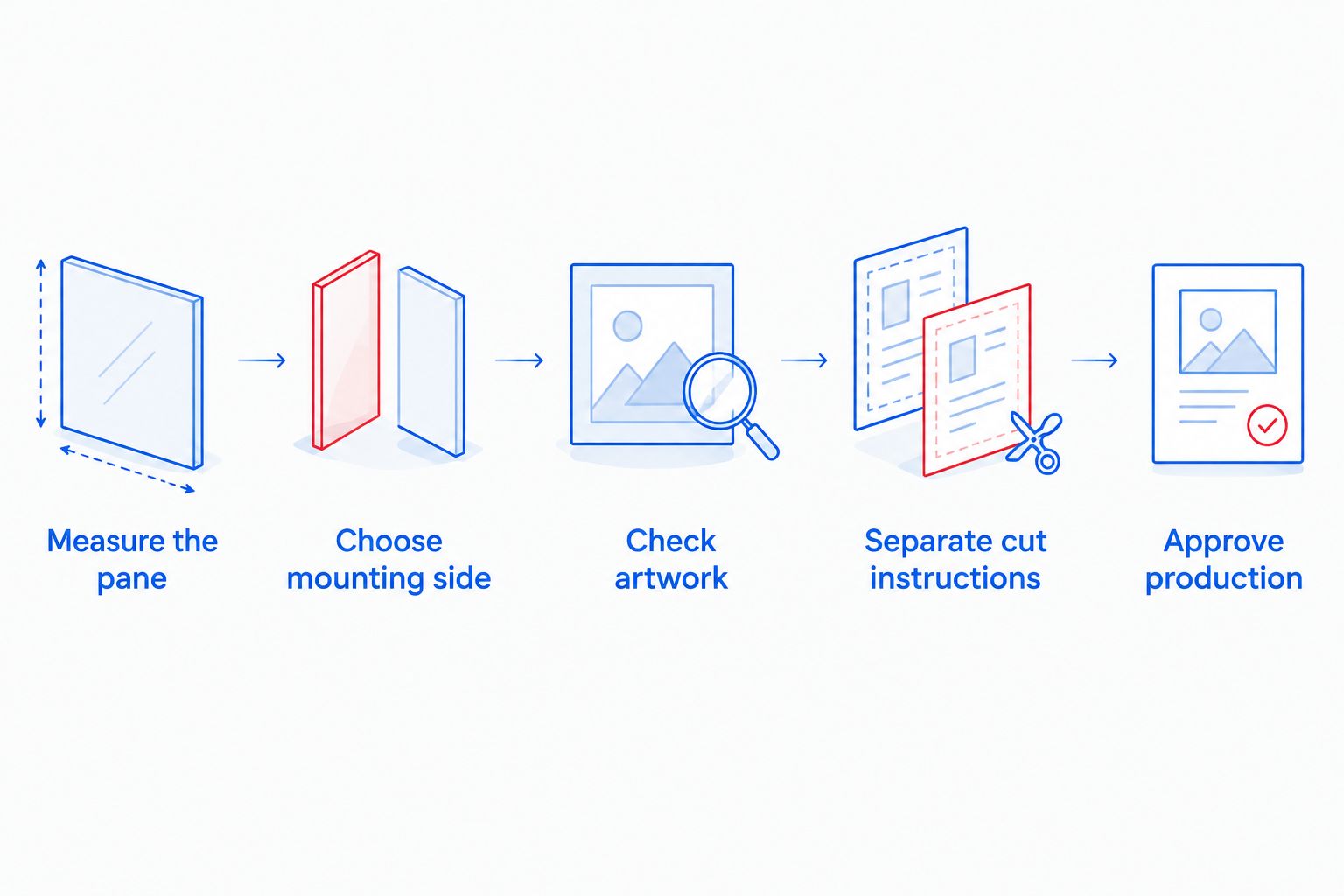
Measure the pane
Record usable glass width and height, then identify handles, frames, seals, and existing graphics. Specify the finished graphic size rather than asking production to estimate it from a storefront photograph.
Choose mounting side
Write inside-glass or outside-glass in the brief. If the graphic mounts inside but reads from outside, ask the printer to confirm the required film, ink construction, and artwork orientation before changing the file yourself.
Check artwork
Use vector artwork for logos and lettering where available. For raster artwork, check detail at final output dimensions; enlarging a preview does not add image detail. Remove unintended backgrounds and identify any white elements that must print.
Separate cut instructions
Distinguish printed artwork from the intended cut path. State whether you need individual shapes or a larger panel, and ask which file setup the printer requires rather than assuming a particular cut-line convention.
Approve production
Review dimensions, wording, material, mounting side, and quantities together. Keep the approved file and specification under a clear revision name so a repeat order does not inherit an outdated promotion.
Confirm mounting side before approving the production file.
The fastest useful approval is a complete approval. Resolve material and artwork questions together instead of approving an image first and discovering an incompatible mounting requirement afterward.
Keep apparel and window production specifications separate
Print shops supplying both garments and storefront graphics should maintain separate job specifications. DTF gang sheets belong to apparel-transfer production; window decals require their own material and mounting instructions.
For a combined 2026 campaign, shared artwork does not mean shared output files. A chest logo, a large window mark, and a small opening-hours panel need different finished dimensions and placement checks.
Brooklyntransfers states that DTF orders placed by 1:00 PM Eastern ship or are ready for pickup the same day. That is a DTF dispatch or pickup statement, not a vinyl-decal turnaround promise and not same-day delivery. Confirm the schedule for the decal order separately.
How the materials rank
The ranking prioritizes fit to the brief: finish, background, adhesive, then application requirements. Matte Cal Vinyl leads for a low-gloss specification; Clear Cal Vinyl, White Static Cling, and Glossy Cal Vinyl each occupy a different use case.
These are specification-based recommendations, not a durability test. No service-life ranking follows from film thickness alone, and no listed material earns an outdoor-use promise without confirmation for the proposed installation.
Which storefront decal should you choose?
Choose Matte Cal Vinyl if your undecided brief calls for a low-gloss, permanent-adhesive graphic. Switch to Clear Cal Vinyl when transparent film is essential, White Static Cling when avoiding adhesive comes first, or Glossy Cal Vinyl when gloss is specified.
For 2026 repeat orders, save the approved material name alongside the artwork revision. Reordering the image without the material specification leaves room for an unwanted finish or adhesive change.
FAQ
What's the best vinyl decal for a storefront window?
Matte Cal Vinyl is the default recommendation for a low-gloss, permanent-adhesive storefront graphic. Choose Clear Cal Vinyl for transparent film or White Static Cling when the application requires no adhesive.
Is static cling better than permanent-adhesive vinyl for promotions?
White Static Cling is the better match when avoiding adhesive is the requirement. Permanent-adhesive vinyl fits a different specification; neither construction alone establishes outdoor lifespan or a reuse count.
Can customers see through clear window decals?
Clear Cal Vinyl has transparent film, but visibility through the finished graphic depends on the printed artwork and ink construction. Confirm which areas should stay clear and which elements must appear opaque.
Should storefront decals go inside or outside the glass?
Choose the mounting side before approving the material and artwork. An inside-mounted graphic viewed from outside needs the printer to confirm construction and orientation; do not assume every decal supports that arrangement.
Does thicker vinyl last longer on storefront windows?
Film thickness alone does not establish storefront service life. The listed materials range from 3 mil calendered vinyl to 7 mil static cling, but their different constructions serve different requirements.
Can I use a DTF gang sheet for window decals?
Do not substitute an apparel DTF gang sheet for a specified window decal. Order the window-signage material and provide its mounting side, viewing direction, dimensions, and cutting requirements separately.
Does Brooklyntransfers promise same-day delivery for storefront decals?
The stated same-day policy concerns DTF dispatch or pickup readiness for orders placed by 1:00 PM Eastern, not storefront-decal delivery. Confirm the vinyl order's production and delivery schedule separately.
One last thing
Walk outside before approving the proof. Look at the pane from the customer's actual approach, not just from directly in front of it. A correct material cannot rescue lettering hidden behind a door handle or placed against a visually busy background.
Put that viewing position into your production brief. It gives the printer a useful requirement rather than another attractive mockup.